Understanding CBAM: What you need to know
As CBAM reshapes the way carbon emissions are reported and priced, staying informed is essential. Our FAQs break down the key details. making it easier for your business to adapt, comply, and stay ahead of regulatory changes. Information accurate as of April 2026*
Will the EU CBAM go ahead despite pushback from the US, amongst others?
Yes. The EU CBAM is already established in EU law and its transitional phase has been in force since October 2023. While some countries like the US have expressed concerns about trade impacts, these objections do not prevent the EU from implementing CBAM. The EU has consistently and repeatedly stated that CBAM will proceed as planned.
If others, such as Türkiye, create their own ETS systems, will they be exempt from the EU CBAM?
No. Establishing a domestic ETS does not automatically exempt a country from the EU CBAM. For an exemption, the EU would need to formally recognise the country’s system as equivalent to the EU ETS, including comparable carbon prices, scope and MRV standards. At present, no non-EEA country has this recognition. If Türkiye were to introduce an ETS, CBAM would still apply unless an equivalency or linking agreement is reached, however any carbon price paid domestically by Turkish producers would potentially reduce their EU CBAM liability.
How will emissions be verified under the EU CBAM?
During the transitional period, importers must report embedded emissions using EU-approved calculation methods, but verification by an accredited verifier is not required. From the definitive phase (1 January 2026 onward), embedded emissions must be verified by an independent, EU accredited verifier following the same standards used under the EU ETS, including checks on data quality, monitoring systems and calculation methodologies. Only emissions verified according to these EU rules will be accepted for calculating the CBAM obligation. Facilities outside the EU need to adopt EU-compliant MRV practices to ensure actual emissions data can be used.
The CBAM phase in rate means importers will only have to account for 2.5% of their emissions in 2026, is this correct?
No. The 2.5% refers to the phase out of free allocation to EU producers. Importers must report 100% of their embedded emissions and the CBAM liability they face will be determined by several factors including: emissions intensity vs the EU benchmarks, any carbon price paid domestically and the volume they import. For many importers this will be far higher than 2.5% of their emissions.
The payment obligation under CBAM begins from 2026 but CBAM certificates will not be available to purchase until 2027, correct?
Yes. The EU CBAM Regulation enters its definitive phase on 1st January 2026, meaning importers will have financial obligations from that date. However, the sale of certificates will not begin until 1st February 2027, with importers purchasing certificates in 2027 for the embedded emissions of 2026 imports. However, it is possible to hedge CBAM certificate price risk now, see below.
How can an importer hedge today when they do not know the exact quantity of CBAM certificates they will need?
Importers seeking to lock in deliveries for 2026 and beyond have a need to protect their profit margins. While it is not yet possible to know with certainty the exact quantity of CBAM certificates each one will require, recent draft legislation allows companies like Redshaw Advisors to provide a reasonably accurate estimate. Even a partial hedge to protect profits is better than no hedge.
How are the benchmarks determined?
Benchmark values of the carbon intensity of the production of goods that are subject to EU CBAM are derived from the EU ETS emissions benchmarking system. They are calculated using the average emissions intensity, of different product categories, of the top performing installations in the EU. Provisional benchmarks have been released but are subject to further updates in 2026. For importers calculating their 2026 CBAM exposure, the Commission have confirmed the provisional benchmarks already circulated will be used. From 2027, CBAM exposure will be calculated using the updated and finalised EU benchmarks.
What are default values and how will they be applied?
Default values are EU-provided emission intensity factors that can be used when actual embedded emissions data from a non-EU installation is unavailable or cannot be verified. In these situations, the EU applies conservative default values to ensure that the CBAM obligation is not underestimated, meaning that importers will likely face a much higher CBAM exposure unless actual verified data is provided. The use of default values is likely to be especially prevalent for complex goods, where verified emissions data would have to be provided for every step of the manufacturing process, often involving multiple suppliers and processes.
What happens if the embedded emissions value provided by our supplier is lower than the produce of the estimated benchmark and the 2026 CBAM factor? In that case, the result of your formula would be negative, how is this treated?
If the emissions intensity of the embedded emissions is lower than the EU benchmark multiplied by the CBAM factor (97.5% in 2026 and falling thereafter), the CBAM liability would be zero.
Is the process to request CBAM Declarant status already open?
Yes, but speed of progress depends on the member state where the importation takes place. CBAM declarants must obtain authorisation before the first import of covered goods in the definitive phase, otherwise importers face an expensive penalty. Some national authorities have already provided authorisation to CBAM declarants while other member states have experienced delays.
Can we convert currently available EU Allowances (EUAs) into CBAM certificates?
No, EUAs cannot be converted into CBAM certificates, they may only be used for compliance under the EU Emissions Trading System. While EUAs may be useful for hedging some of an importer’s CBAM price risk, even with careful management and market knowledge they can’t be a perfect hedge for CBAM certificate prices.
Is it correct that CBAM certificates cannot be banked?
CBAM certificates cannot be used to meet future years’ CBAM liabilities. However, should an importer buy too many CBAM certificates, they will have a two-year period following the surrender in which to sell back any unused certificates. After approximately two years any unused certificates will be cancelled.
How will CBAM benchmarks be defined? For example, will there be one benchmark per product (e.g. hot rolled alloy steel)?
Benchmarks reflect ETS benchmarks that are applicable for 2026-2030 but for CBAM they have been defined per product category or CN code. However, for complex goods several benchmarks may need to be applied to reflect the various stages of the production process.
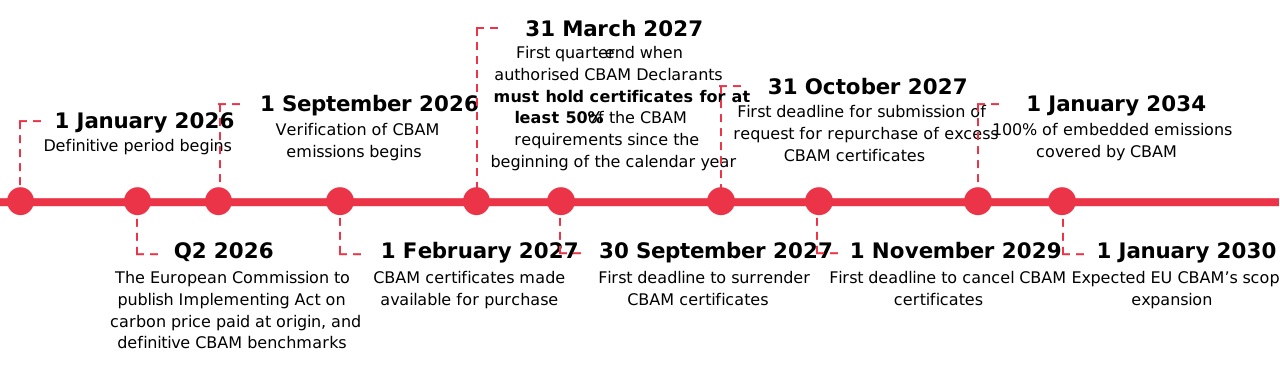
Can you clarify the timeline of EU and UK CBAM deadlines, including certificate purchase and submission dates, declaration deadlines and any other relevant milestones?
For the EU CBAM, the transitional phase ran from 1 October 2023 – 31 December 2025 (reporting obligations only), the definitive phase began on 1 January 2026. CBAM certificates will not be available to purchase until February 2027, ahead of the first surrender and reporting deadline for 2026 import emissions on 30th September 2027. The annual reporting and surrender deadline will be on the same date each year thereafter. For the UK CBAM, the UK Government plans for it to enter its definitive phase on 1 January 2027 but the other details have not yet been revealed, including reporting and surrender deadlines.